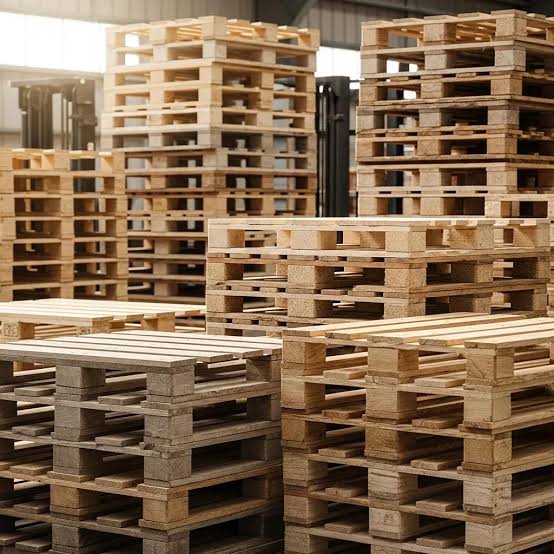
Standard Wooden Pallet Sizes in Europe: Dimensions & Specifications
When choosing pallets for transport, warehousing or export, wooden pallet sizes are one of the first specifications to consider. The correct pallet dimensions affect how goods are packed, how much warehouse space is used, how efficiently trucks and containers are loaded, and whether pallets are compatible with handling equipment. wooden pallet sizes
In Europe, the 1,200 × 800 mm Euro pallet is one of the most widely recognized pallet formats, while 1,200 × 1,000 mm, 1,000 × 1,200 mm and other industrial dimensions are also widely used.
However, there is no single wooden pallet size suitable for every application.
The right pallet depends on the product, load, warehouse equipment, transport system, storage configuration and export requirements. wooden pallet sizes
This guide explains the most common wooden pallet sizes in Europe, their dimensions, applications, load considerations and the differences between Euro pallets, industrial pallets, one-way pallets and custom pallets. wooden pallet sizes
What Are the Standard Wooden Pallet Sizes?
Common wooden pallet dimensions used in Europe include:
| Pallet Size | Typical Description | Common Applications |
|---|---|---|
| 1200 × 800 mm | Euro / EPAL format | General logistics, retail, warehousing |
| 1200 × 1000 mm | Industrial format | Manufacturing, heavier products |
| 1000 × 1200 mm | Industrial / EPAL format | Industrial logistics and distribution |
| 800 × 600 mm | Half pallet | Retail, displays, smaller loads |
| 1140 × 1140 mm | Industrial / sector-specific | Certain export and industrial applications |
| 1100 × 1300 mm | Large industrial format | Heavy or oversized products |
| Custom dimensions | Made to specification | Machinery, special products, export |
The exact construction, height, board configuration and load capacity can vary significantly even when two pallets have the same footprint.
This is why buyers should specify more than just the length and width.
1200 × 800 mm Euro Pallet
The 1,200 × 800 mm format is one of the most important pallet dimensions in European logistics.
The official EPAL Euro pallet has:
- Length: 1,200 mm
- Width: 800 mm
- Height: 144 mm
- Approximate weight: 25 kg
- Safe working load: 1,500 kg
- 11 boards
- 9 blocks
- 78 nails
These specifications are published by EPAL for the EPAL Euro pallet.
The 1200 × 800 mm format is widely used for:
- Warehousing
- Retail distribution
- Manufacturing
- Food and beverage logistics
- Road transport
- Export
- Distribution centers
- Automated material handling
- General commercial logistics
- wooden pallet sizes
The important distinction is that not every 1200 × 800 mm wooden pallet is an EPAL pallet.
A pallet can have the same external dimensions while having a different construction, load rating, board thickness, nail pattern or certification status.
If you specifically require EPAL pallets, see our Euro EPAL Pallets Portugal page.
1200 × 1000 mm Industrial Pallets
The 1,200 × 1,000 mm footprint is another major pallet format used in industrial logistics.
Compared with the 1200 × 800 mm Euro format, it provides a larger base area.
This can be useful for:
- Industrial products
- Machinery
- Larger cartons
- Manufacturing components
- Chemical products
- Building materials
- Heavy loads
- Warehouse storage
- Export cargo
- wooden pallet sizes
The 1200 × 1000 mm format is also represented within the EPAL load-carrier range. EPAL currently lists the EPAL 2 pallet at 1,200 × 1,000 × 162 mm, with a stated safe working load of 1,250 kg.
However, an industrial pallet measuring 1200 × 1000 mm does not automatically have the same specifications as an EPAL 2 pallet.
When buying standard industrial pallets, always confirm the actual construction and load rating supplied.
For heavy industrial applications, see our Industrial Pallets Portugal page.
1000 × 1200 mm Wooden Pallets
The 1,000 × 1,200 mm configuration is also widely used in industrial logistics.
It is essentially the same footprint dimensions as 1200 × 1000 mm but with the orientation reversed.
This format can be useful where the pallet needs to be positioned in a specific direction for:
- Forklift access
- Warehouse racking
- Production lines
- Container loading
- Conveyor systems
- Automated handling
- Industrial storage
- wooden pallet sizes
EPAL lists the EPAL 3 pallet at 1,000 × 1,200 × 144 mm, with a safe working load of 1,500 kg.
Again, buyers should distinguish between a generic industrial pallet and a pallet manufactured to a specific EPAL technical specification.
800 × 600 mm Half Pallets
Half pallets are useful when a full-size pallet would provide more capacity than necessary.
The 800 × 600 mm format is commonly associated with half-pallet applications.
Typical uses include:
- Retail
- Promotional displays
- Smaller product quantities
- Point-of-sale distribution
- Consumer goods
- Smaller warehouse loads
- Partial shipments
- wooden pallet sizes
EPAL currently lists both EPAL 6 and EPAL 7 half pallets at 800 × 600 mm, although their heights and safe working loads differ. EPAL lists EPAL 6 at 144 mm high with a 750 kg safe working load and EPAL 7 at 163 mm high with a 500 kg safe working load.
This illustrates an important point:
Pallet footprint alone does not determine load capacity.
Other Wooden Pallet Sizes Used in Europe
Beyond the most common formats, businesses may require larger or specialized pallet dimensions.
Examples include:
- 1,140 × 1,140 mm
- 1,100 × 1,300 mm
- 760 × 1,140 mm
- 1,300 × 1,100 mm
- 1,000 × 1,200 mm
- 1,200 × 1,000 mm
EPAL’s current product range includes several CP pallet formats, including CP3 at 1,140 × 1,140 mm, CP4 at 1,100 × 1,300 mm, CP5 at 760 × 1,140 mm and CP7 at 1,300 × 1,100 mm.
These formats demonstrate why businesses should select pallet dimensions according to the actual supply-chain requirement rather than assuming that every wooden pallet should be 1200 × 800 mm.
Wooden Pallet Size Comparison
The following table provides a practical overview of common pallet footprints.
| Size | Typical Category | Typical Use |
|---|---|---|
| 1200 × 800 mm | Euro pallet | European logistics and general distribution |
| 1200 × 1000 mm | Industrial pallet | Manufacturing and heavier products |
| 1000 × 1200 mm | Industrial / EPAL | Industrial distribution |
| 800 × 600 mm | Half pallet | Retail and smaller loads |
| 1140 × 1140 mm | Industrial / sector-specific | Industrial and export applications |
| 1100 × 1300 mm | Large industrial | Large products and industrial cargo |
| 760 × 1140 mm | Sector-specific | Specialized logistics |
| Custom | Custom pallet | Machinery, oversized and unusual loads |
Why Wooden Pallet Dimensions Matter
Choosing the right dimensions is not simply about making sure the product fits on the pallet.
The pallet footprint influences the entire logistics process.
1. Product Fit
The pallet should provide a stable base for the product.
A pallet that is too small can create overhang and instability.
A pallet that is significantly larger than the product may waste space.
The ideal configuration depends on:
- Product dimensions
- Packaging dimensions
- Weight
- Center of gravity
- Stacking requirements
- Handling method
- wooden pallet sizes
2. Truck Loading
Pallet dimensions directly affect how many pallets can be loaded into a vehicle.
The objective is normally to maximize usable cargo space while maintaining safe loading arrangements.
For this reason, European distribution operations frequently use standardized footprints.
However, the optimum arrangement depends on:
- Trailer dimensions
- Pallet orientation
- Product dimensions
- Loading restrictions
- Weight distribution
- Access requirements
3. Container Loading
Pallet size is also important when goods are transported in shipping containers.
A poorly selected pallet footprint can create unused spaces inside the container.
For export cargo, businesses should consider the pallet dimensions together with:
- Product dimensions
- Packaging
- Container dimensions
- Load height
- Total cargo weight
- Loading sequence
- wooden pallet sizes
For international shipments, see our Export Pallets Portugal page.
Pallet Size and Warehouse Storage
Warehouse storage is another major consideration.
A pallet should be compatible with the storage system where it will be used.
Common systems include:
- Floor stacking
- Selective pallet racking
- Drive-in racking
- Push-back racking
- Automated storage
- Conveyor systems
The pallet footprint, construction and bottom-board arrangement can affect whether a pallet is suitable for a particular racking system.
Therefore, buyers should not select a pallet based solely on external dimensions.
Before ordering, confirm:
- Pallet dimensions
- Pallet height
- Static load
- Dynamic load
- Racking load
- Forklift compatibility
- Rack compatibility
- Entry direction
- Product dimensions
- Storage configuration
- wooden pallet sizes
Wooden Pallet Size and Load Capacity
One of the most common mistakes when buying pallets is assuming that pallet dimensions determine load capacity.
They do not.
Two pallets measuring 1200 × 800 mm can have very different load capacities.
Capacity can be affected by:
- Timber species
- Board thickness
- Board width
- Number of deck boards
- Number of bottom boards
- Block dimensions
- Stringer design
- Nail pattern
- Pallet construction
- Load distribution
- Support conditions
- Handling method
- wooden pallet sizes
For example, the official EPAL Euro pallet has a stated safe working load of 1,500 kg under the specified conditions.
That figure should not automatically be applied to every generic 1200 × 800 mm wooden pallet.
For heavy products, see our Industrial Pallets solutions.
Static, Dynamic and Racking Load
When discussing pallet capacity, it is useful to distinguish between different loading conditions.
Static Load
Static load refers to the load carried while the pallet is stationary, such as during floor storage.
Dynamic Load
Dynamic load refers to the load when the pallet is being moved using handling equipment such as a forklift or pallet truck.
Racking Load
Racking load refers to the load carried when the pallet is supported by a warehouse racking system.
These values can be different.
Therefore, a pallet specification should ideally state the relevant loading conditions rather than simply providing one generic “maximum weight.”
How to Choose the Right Wooden Pallet Size
The best pallet size depends on your application.
Use the following process.
Step 1: Measure the Product
Measure:
- Length
- Width
- Height
- Weight
Include the outer dimensions of the packaging.
Step 2: Determine the Required Orientation
Consider how the product should sit on the pallet.
Ask:
- Can the product overhang?
- Must all sides remain inside the pallet footprint?
- Does the product need to be accessed from a particular direction?
- Will multiple products be loaded onto one pallet?
Step 3: Calculate the Pallet Load
Determine the total weight of the products and packaging.
Do not forget:
- Product weight
- Packaging weight
- Pallet weight
- Additional protective material
Step 4: Consider Handling Equipment
Confirm whether the pallet will be moved by:
- Forklift
- Hand pallet truck
- Automated guided vehicle
- Conveyor
- Warehouse stacker
- wooden pallet sizes
The pallet construction should match the equipment.
Step 5: Consider Storage
If the pallet will be stored in racking, confirm the exact rack requirements before ordering.
Step 6: Consider Transport
If the pallet will travel by:
- Truck
- Container
- Rail
- Sea freight
- Air freight
consider the available loading space and weight limitations.
Step 7: Determine Whether Standard or Custom Is Better
If your product fits efficiently on a standard pallet, a standard size can simplify purchasing and logistics.
If the product is unusually shaped or oversized, a custom pallet may be more appropriate.
See our Custom Pallets options for non-standard dimensions.
Standard vs Custom Wooden Pallets
Standard Pallets
Standard pallets are useful when:
- Products fit existing dimensions
- Warehouse systems are standardized
- Pallets are exchanged or reused
- Transport systems are already configured
- Large quantities are purchased
Common standard formats include 1200 × 800 mm and 1200 × 1000 mm.
Custom Pallets
Custom pallets can be designed around:
- Machinery
- Industrial equipment
- Long products
- Wide products
- Heavy components
- Export packaging
- Special handling requirements
- wooden pallet sizes
Custom dimensions can help reduce product overhang and improve load stability.
Are 1200 × 800 mm Pallets the Same as Euro Pallets?
Not necessarily.
A 1200 × 800 mm pallet describes the footprint.
An EPAL Euro pallet describes a pallet manufactured according to the applicable EPAL specifications and identification requirements.
The official EPAL Euro pallet is 1200 × 800 × 144 mm and has a stated safe working load of 1,500 kg.
Therefore, when purchasing, specify whether you need:
- Generic 1200 × 800 mm pallets
- Euro-size pallets
- EPAL Euro pallets
- New pallets
- Used pallets
- Export-treated pallets
- Custom pallets
- wooden pallet sizes
This distinction is particularly important when pallets are being exchanged or used within standardized logistics systems.
Wooden Pallet Dimensions for Export
Export shipments require additional planning because the pallet has to work within the complete international logistics chain.
Depending on the shipment and destination requirements, wooden export pallets may need to meet applicable ISPM 15 requirements.
ISPM 15 addresses phytosanitary measures for regulated wood packaging material used in international trade.
For exporters, pallet selection should therefore consider:
- Dimensions
- Load capacity
- Product fit
- Container utilization
- Handling equipment
- Treatment requirements
- Marking requirements
- Destination-country regulations
- wooden pallet sizes
Read our detailed ISPM 15 Wooden Pallets Guide for more information.
Wooden Pallet Dimensions for Different Industries
Different industries often have different pallet requirements.
Manufacturing
Manufacturers may require:
- 1200 × 1000 mm
- 1000 × 1200 mm
- Heavy-duty industrial pallets
- Custom pallets
Retail
Retail distribution frequently uses standardized formats such as:
- 1200 × 800 mm
- 800 × 600 mm
Food and Beverage
Food and beverage logistics may use standard Euro pallets as well as specialized hygienic pallet systems depending on the operation.
Machinery
Machinery often requires:
- Custom dimensions
- Reinforced construction
- Heavy-duty timber
- Additional support blocks
- Special securing arrangements
Export
Exporters may use:
- Euro pallets
- Industrial pallets
- One-way pallets
- Custom export pallets
- ISPM 15-compliant wooden pallets
- wooden pallet sizes
Wooden Pallet Size Specification Table
When requesting a quotation, provide as many of the following specifications as possible.
| Specification | Example |
|---|---|
| Length | 1200 mm |
| Width | 800 mm |
| Height | 144 mm |
| Type | Euro / industrial / custom |
| Condition | New / used |
| Load | 1,000 kg / 1,500 kg / specified requirement |
| Entry | 2-way / 4-way |
| Deck | Open / closed / specific board configuration |
| Treatment | ISPM 15 / heat treated where required |
| Application | Warehouse / transport / export |
| Quantity | 100 / 500 / 1,000+ units |
| Destination | Portugal / Europe / export destination |
Providing these details makes it easier for a pallet supplier to recommend an appropriate construction.
How Pallet Dimensions Affect Pallet Weight
The dimensions of a pallet can influence its weight, but footprint alone does not determine it.
Pallet weight also depends on:
- Timber density
- Moisture content
- Board dimensions
- Number of components
- Nail quantity
- Block design
- Construction method
For example, EPAL lists the standard EPAL Euro pallet at approximately 25 kg.
A generic 1200 × 800 mm pallet may weigh more or less depending on its construction.
Common Mistakes When Choosing Pallet Sizes
Mistake 1: Choosing Only by Price
The cheapest pallet may not be suitable for the actual load.
Mistake 2: Ignoring Height
Pallet height matters for:
- Truck loading
- Container loading
- Warehouse storage
- Racking
- Automated systems
- wooden pallet sizes
Mistake 3: Confusing Footprint With Certification
1200 × 800 mm does not automatically mean EPAL.
Mistake 4: Ignoring Racking Requirements
A pallet suitable for floor storage may not be suitable for a particular rack system.
Mistake 5: Ignoring Export Requirements
Wooden pallets used internationally may need to comply with applicable phytosanitary rules.
Mistake 6: Using the Wrong Load Rating
Always specify the required load under the actual handling and storage conditions.
Wooden Pallet Sizes: Quick Reference
For a quick starting point:
1200 × 800 mm
Best known as the European Euro pallet footprint and widely used for general logistics.
1200 × 1000 mm
Common industrial footprint with a larger base area.
1000 × 1200 mm
Another major industrial configuration.
800 × 600 mm
Half-pallet format suitable for smaller loads and retail applications.
1140 × 1140 mm and larger formats
Used for specific industrial and sector applications.
Custom sizes
Useful for machinery, oversized products and specialized export requirements.
The final selection should always be based on the product, load, storage system and transport requirements.
Frequently Asked Questions About Wooden Pallet Sizes
What is the standard wooden pallet size in Europe?
The 1200 × 800 mm Euro pallet is one of the most widely recognized wooden pallet formats in Europe. The official EPAL Euro pallet measures 1200 × 800 × 144 mm.
What is the most common industrial pallet size?
1200 × 1000 mm and 1000 × 1200 mm are widely used industrial configurations. The appropriate choice depends on the product, handling equipment and warehouse system.
What size is an EPAL Euro pallet?
The EPAL Euro pallet measures 1200 × 800 × 144 mm and has a stated safe working load of 1,500 kg under EPAL’s specified conditions.
Is 1200 × 800 the same as EPAL?
No. 1200 × 800 mm describes the pallet footprint. EPAL refers to a specific pallet system with defined construction, markings and technical requirements.
What size pallet should I use for heavy products?
There is no single answer. Heavy products may require an industrial or custom pallet with reinforced construction and a load capacity appropriate to the actual application.
Can I order custom wooden pallet dimensions?
Yes. Custom pallets can be designed for machinery, oversized products, unusual packaging and specialized transport requirements.
See our Custom Pallets page.
What pallet size is best for export?
The appropriate size depends on the product, transport mode, container or trailer, handling equipment and destination requirements. Export pallets may also need to comply with applicable ISPM 15 requirements. wooden pallet sizes
Are wooden pallet dimensions standardized worldwide?
No. Several standardized formats are widely used, but pallet dimensions vary by region, industry, logistics system and application.
Does a larger pallet carry more weight?
Not automatically. Load capacity depends on pallet construction, timber, board configuration, support conditions and the intended application. wooden pallet sizes
How do I choose between 1200 × 800 and 1200 × 1000 mm?
Compare the product footprint, weight, warehouse system, transport configuration and required load capacity. The larger footprint is not automatically better if it creates unused space.
Need the Right Wooden Pallet Size?
Choosing the correct pallet dimensions can improve:
- Load stability
- Warehouse utilization
- Truck loading
- Container utilization
- Material handling
- Product protection
- Storage efficiency
- wooden pallet sizes
At Palmal – Paletes de Madeira, we supply wooden pallets for logistics, warehousing, manufacturing, transport and export requirements.
Our pallet solutions include:
- Euro / EPAL pallets
- Industrial pallets
- New wooden pallets
- Used wooden pallets
- Export pallets
- Heat-treated pallets
- ISPM 15 pallets
- One-way pallets
- Custom wooden pallets
- wooden pallet sizes
Explore our Wooden Pallets range or see our Wooden Pallets Portugal page.
If you already know the required dimensions, send us the size, quantity, load requirement, pallet type and delivery destination and request a quotation.
Related Resources
- Wooden Pallets
- Wooden Pallets Portugal
- Euro EPAL Pallets Portugal
- Industrial Pallets Portugal
- New Wooden Pallets
- Used Wooden Pallets
- Export Pallets Portugal
- Custom Pallets
- ISPM 15 Wooden Pallets Guide
- Plastic vs Wooden Pallets
- wooden pallet sizes
Official Technical Reference
For current EPAL product dimensions and specifications, consult the EPAL official product overview. EPAL currently lists the Euro pallet at 800 × 1,200 × 144 mm and also provides specifications for EPAL 2, EPAL 3, half pallets and CP pallet formats. wooden pallet sizes