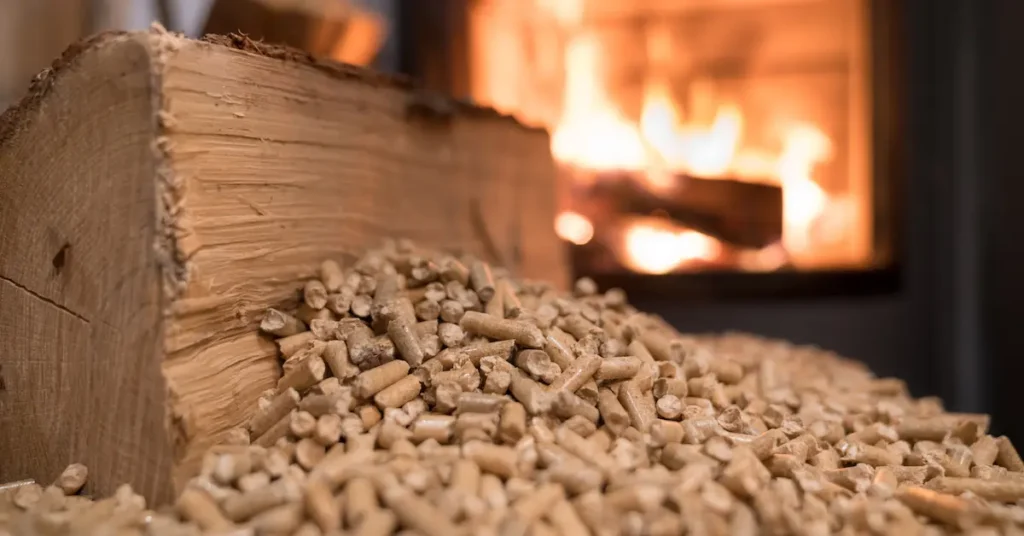
How Many Wood Pellets Does a Pellet Stove Use? Complete Consumption Guide
wood pellet consumption , If you are considering pellet heating, one of the first questions is: how much wood pellets does a pellet stove use?
There is no single consumption figure that applies to every stove or home. Pellet consumption depends on the stove’s rated power, operating level, heating demand, insulation, outdoor temperature, thermostat settings and the number of hours the appliance operates.
As a practical starting point, many domestic pellet stoves consume around 0.5 to 2.5 kg of pellets per hour, depending on the appliance and operating power. Some systems can consume less at minimum output or more at higher output.
A stove running at 1 kg per hour for 8 hours would use approximately:
1 kg × 8 hours = 8 kg per day
A 15 kg bag would therefore last approximately:
15 ÷ 1 = 15 operating hours
These are examples, not universal consumption ratings. The manufacturer’s technical specification should always be used for the actual appliance.
This guide explains how to calculate pellet consumption, estimate daily and monthly usage, understand the factors affecting fuel consumption and choose the appropriate pellet supply format.
How Much Wood Pellets Does a Pellet Stove Use Per Hour?
Pellet stove consumption is usually expressed in kilograms per hour.
A simplified example is:
| Consumption | 1 Hour | 8 Hours | 24 Hours |
|---|---|---|---|
| 0.5 kg/h | 0.5 kg | 4 kg | 12 kg |
| 1.0 kg/h | 1 kg | 8 kg | 24 kg |
| 1.5 kg/h | 1.5 kg | 12 kg | 36 kg |
| 2.0 kg/h | 2 kg | 16 kg | 48 kg |
| 2.5 kg/h | 2.5 kg | 20 kg | 60 kg |
These figures assume continuous operation at the stated consumption rate.
In real use, a stove may cycle between different output levels rather than operating continuously at maximum consumption.
How Many Pellets Does a 15kg Bag Last?
The answer depends on the stove’s actual consumption.
The basic calculation is:
Bag duration = Bag weight ÷ pellet consumption per hour
For a 15 kg bag:
At 0.5 kg/h
15 ÷ 0.5 = 30 hours
At 1 kg/h
15 ÷ 1 = 15 hours
At 1.5 kg/h
15 ÷ 1.5 = 10 hours
At 2 kg/h
15 ÷ 2 = 7.5 hours
At 2.5 kg/h
15 ÷ 2.5 = 6 hours
These are theoretical operating times if the appliance continuously consumes pellets at the specified rate.
Actual bag duration can be different because pellet stoves commonly modulate their output.
For bagged supply, see our 15kg Wood Pellets page.
How Many 15kg Bags Does a Pellet Stove Use Per Day?
To estimate daily consumption, multiply the hourly consumption by the number of operating hours.
Example 1: Low Consumption
A stove consumes 0.7 kg/h and operates for 8 hours:
0.7 × 8 = 5.6 kg/day
That is approximately:
5.6 ÷ 15 = 0.37 bags/day
Example 2: Medium Consumption
A stove consumes 1.2 kg/h for 8 hours:
1.2 × 8 = 9.6 kg/day
Approximately:
9.6 ÷ 15 = 0.64 bags/day
Example 3: Higher Consumption
A stove consumes 2 kg/h for 10 hours:
2 × 10 = 20 kg/day
Approximately:
20 ÷ 15 = 1.33 bags/day
Again, these are calculation examples rather than predictions for a particular home.
How Many Wood Pellets Does a Pellet Stove Use Per Month?
Monthly consumption depends on:
- Daily operating hours
- Average pellet consumption
- Heating demand
- Weather
- Building insulation
- Stove settings
- wood pellet consumption
The basic formula is:
Monthly consumption = kg/hour × operating hours/day × operating days/month
For example:
1.2 kg/h × 8 hours/day × 30 days = 288 kg/month
At 15 kg per bag:
288 ÷ 15 = 19.2 bags/month
Therefore, the example household would require approximately 19–20 bags of 15 kg for that operating pattern. wood pellet consumption
Monthly Wood Pellet Consumption Examples
| Average Consumption | Hours/Day | Approx. Daily Use | 30-Day Use | 15kg Bags/Month |
|---|---|---|---|---|
| 0.5 kg/h | 8 | 4 kg | 120 kg | 8 |
| 0.75 kg/h | 8 | 6 kg | 180 kg | 12 |
| 1.0 kg/h | 8 | 8 kg | 240 kg | 16 |
| 1.25 kg/h | 8 | 10 kg | 300 kg | 20 |
| 1.5 kg/h | 8 | 12 kg | 360 kg | 24 |
| 2.0 kg/h | 8 | 16 kg | 480 kg | 32 |
These figures are mathematical examples based on continuous operation at the stated rate.
Actual household consumption can be considerably different because the appliance may operate at variable output.
Does a Pellet Stove Run at Maximum Consumption All the Time?
Usually, the answer depends on the appliance and its control system.
Many modern pellet heating systems can modulate their output according to heating demand.
For example, a stove may:
- Start at a higher output.
- Heat the room.
- Reduce output after reaching the target temperature.
- Cycle or maintain a lower operating level.
- wood pellet consumption
This means that a stove with a maximum consumption of 2 kg/h may not consume 2 kg every hour throughout the day.
This is why using the maximum consumption figure as an everyday average can significantly overestimate actual fuel use.
What Determines Wood Pellet Consumption?
Several factors affect how many pellets a heating system uses.
1. Stove Power
A higher-output appliance can consume more fuel when operating at high power.
For example, a larger stove designed to deliver substantially more heat will generally have a higher maximum fuel consumption than a smaller unit.
Always check the manufacturer’s rated minimum and maximum pellet consumption.
2. Operating Hours
The longer the stove runs, the more fuel it can consume.
For example:
1 kg/h × 5 hours = 5 kg
while:
1 kg/h × 10 hours = 10 kg
Doubling the operating time approximately doubles consumption if the average fuel rate remains unchanged.
3. Thermostat Setting
A higher indoor temperature can increase heating demand.
For example, maintaining a room at a higher target temperature generally requires more heat than maintaining a lower target temperature, although the difference depends on the building and weather.
4. Outdoor Temperature
Cold weather increases the heat loss from a building.
If outdoor temperatures fall significantly, the heating system may need to operate longer or at a higher output.
This can increase pellet consumption.
5. Building Insulation
Insulation can have a major influence on heating demand.
A well-insulated building can require less heating energy than a poorly insulated building under otherwise similar conditions.
Relevant areas include:
- Roof
- Walls
- Windows
- Doors
- Floors
- Air leakage
Room Size and Pellet Consumption
Room size matters, but it is not the only factor.
Two homes with the same floor area can have very different heating requirements because of:
- Ceiling height
- Insulation
- Window area
- Building orientation
- Outdoor temperature
- Construction quality
- Number of rooms being heated
- Desired indoor temperature
- wood pellet consumption
Therefore, pellet consumption should not be calculated from floor area alone.
How Much Heat Do Wood Pellets Provide?
The useful energy available from pellets depends on their heating value and the efficiency of the heating appliance.
A simplified energy relationship is:
Useful heat = pellet quantity × pellet heating value × appliance efficiency
For example, if a pellet has a heating value of approximately 4.8 kWh/kg, then 1 kg contains approximately 4.8 kWh of chemical energy.
If a heating appliance operates at an assumed efficiency of 90%, the theoretical useful heat would be:
4.8 × 0.90 = 4.32 kWh
This is an illustrative calculation, not a universal efficiency rating.
Actual results depend on the pellet specification, appliance, operating conditions and measurement method.
Pellet Quality and Consumption
Pellet quality can influence appliance operation.
Important characteristics can include:
- Moisture
- Ash
- Mechanical durability
- Fines
- Bulk density
- Heating value
- wood pellet consumption
Consistent pellets can help heating equipment operate predictably when the appliance is properly adjusted.
For certified pellet products, buyers can check the applicable quality classification and certification information.
See our guide:
What Is ENplus A1? Complete Wood Pellet Certification Guide
The official ENplus Quality Scheme provides information about the certification system and quality requirements.
Does ENplus A1 Mean Lower Pellet Consumption?
Not necessarily.
ENplus A1 is a quality classification and certification framework, not a promise that a particular household will consume fewer kilograms of pellets.
Actual consumption depends primarily on:
- Heating demand
- Appliance efficiency
- Stove settings
- Operating hours
- Building characteristics
- Weather
- wood pellet consumption
However, consistent pellet quality can be important for reliable combustion and appliance operation.
The pellet should also be appropriate for the heating equipment according to the manufacturer’s instructions.
How Much Wood Pellet Fuel Does a House Need?
There is no universal amount because homes have very different heating requirements.
A useful approach is to calculate consumption from actual appliance use.
For example:
Average consumption = 1 kg/h
Operating time = 8 hours/day
Heating season = 150 days
Then:
1 × 8 × 150 = 1,200 kg
That equals:
1.2 tonnes of pellets
At 15 kg per bag:
1,200 ÷ 15 = 80 bags
This is a planning example, not a recommended annual quantity.
How Many Tonnes of Wood Pellets Do I Need?
For larger users, it is often easier to calculate consumption in tonnes.
Example
If a heating system consumes an average of:
1.2 kg/hour
for:
8 hours/day
over:
180 days
Then:
1.2 × 8 × 180 = 1,728 kg
or:
1.728 tonnes
The actual requirement should include an appropriate allowance for changes in weather and operating conditions. wood pellet consumption
For larger requirements, see our Wood Pellets Wholesale Portugal page.
Pellet Consumption Calculator
You can calculate approximate fuel consumption using:
Daily consumption
kg/h × hours/day = kg/day
Monthly consumption
kg/h × hours/day × operating days = kg/month
Annual consumption
kg/h × hours/day × operating days/year = kg/year
Number of 15kg bags
Total kg ÷ 15 = number of bags
Tonnes
Total kg ÷ 1,000 = tonnes
Example Pellet Consumption Calculation
Suppose your stove uses:
1.3 kg/h
and operates:
9 hours/day
for:
150 days/year
Calculation:
1.3 × 9 × 150 = 1,755 kg
Annual consumption:
1.755 tonnes
15kg bags:
1,755 ÷ 15 = 117 bags
If each bag contains 15 kg, the theoretical annual requirement would therefore be approximately:
117 bags
Actual consumption may be lower or higher depending on how the stove modulates and actual heating demand.
How Many Bags of Pellets Should I Buy at Once?
This depends on your:
- Daily consumption
- Storage capacity
- Delivery frequency
- Available budget
- Local availability
- Storage conditions
- wood pellet consumption
Buying larger quantities can make sense for regular consumers, but only if there is suitable dry storage space.
There is little benefit in purchasing a large quantity if the storage environment exposes the pellets to moisture.
Read our How to Store Wood Pellets Properly guide.
15kg Bags vs Big Bags vs Bulk
The most appropriate supply format depends on consumption.
| Format | Suitable For | Main Advantage |
|---|---|---|
| 15kg bags | Homes and smaller users | Easy manual handling |
| Big bags | Larger consumers | Higher quantity per unit |
| Bulk | Large heating systems | Efficient high-volume delivery |
| Wholesale | Distributors and retailers | Commercial purchasing |
15kg Bags
Ideal for households that have suitable dry storage and use manageable quantities.
Big Bags
Useful for users who require larger quantities and have appropriate handling equipment.
Bulk
Often practical for heating systems with dedicated storage.
See our Bulk Wood Pellets Portugal page.
How to Reduce Wood Pellet Consumption
The most effective way to reduce fuel consumption is generally to reduce unnecessary heat demand while operating the heating system appropriately.
1. Improve Insulation
Reducing heat loss can reduce heating demand.
Pay attention to:
- Roof insulation
- Wall insulation
- Windows
- Doors
- Air leakage
- wood pellet consumption
2. Use Appropriate Temperature Settings
Avoid unnecessarily high thermostat settings.
A small change in target temperature can affect heating demand depending on the building.
3. Maintain the Heating Appliance
Follow the manufacturer’s maintenance schedule.
A properly maintained appliance can operate more reliably.
Maintenance may include:
- Cleaning the combustion chamber
- Cleaning heat-exchange surfaces
- Checking seals
- Cleaning ash
- Inspecting the flue
- Checking the pellet feed system
- wood pellet consumption
Always follow the appliance manufacturer’s instructions.
4. Use Suitable Pellets
Use pellets compatible with the heating system.
If the appliance manufacturer specifies a particular pellet quality or certification, follow those requirements.
5. Avoid Moisture-Damaged Pellets
Store pellets properly to protect their physical condition.
Moisture can damage the pellet structure and affect handling.
6. Avoid Unnecessary Operating Hours
If the heating system does not need to operate continuously, appropriate thermostat and scheduling controls can reduce unnecessary operation.
Does Stove Size Affect Pellet Consumption?
Yes.
A larger stove designed for higher heat output will generally have a greater maximum fuel consumption than a smaller appliance.
However, a larger stove does not necessarily consume more fuel every day if it is correctly sized and operates at lower output when heating demand is low. wood pellet consumption
The relationship between stove size and fuel use should therefore be considered alongside:
- Building heat loss
- Operating hours
- Output modulation
- Efficiency
- Thermostat settings
Wood Pellet Consumption in Mild vs Cold Weather
Weather can significantly affect consumption.
Mild Weather
A building may require less heating.
The stove may:
- Operate fewer hours
- Run at lower output
- Cycle more frequently
Cold Weather
The building may lose heat faster.
The stove may:
- Operate longer
- Run at higher output
- Consume more fuel
This is why monthly pellet consumption can vary considerably throughout a heating season.
Pellet Consumption for Different Applications
Small Residential Stove
May operate several hours per day and typically uses 15kg bags.
Large Residential Heating System
May require more hours of operation and larger quantities.
Commercial Building
May require bulk or high-volume pellet supply.
Industrial Heating
Can require substantial bulk quantities and dedicated fuel storage.
For industrial applications, see our Industrial Wood Pellets Portugal page.
Wood Pellet Consumption and Heating Efficiency
Fuel consumption should not be considered separately from useful heat output.
Two appliances may consume the same amount of pellets but deliver different amounts of useful heat depending on their efficiency and operating conditions.
A simplified relationship is:
Useful heat output = fuel energy × appliance efficiency
For buyers comparing heating systems, consider both:
- Pellet consumption
- Useful heat delivered
rather than looking at kilograms per hour alone.
Why Your Actual Consumption May Be Different From the Manufacturer’s Figure
Manufacturer specifications are normally based on defined test conditions.
Actual household operation can differ because of:
- Building insulation
- Weather
- Fuel quality
- Thermostat settings
- Chimney/flue conditions
- Maintenance
- Operating mode
- Stove size
- Heating demand
- wood pellet consumption
The manufacturer’s published figures are therefore useful for comparison, but they should not be treated as a guaranteed household consumption rate.
Wood Pellet Consumption: Technical Reference
| Factor | Effect on Consumption |
|---|---|
| Stove output | Higher output can increase consumption |
| Operating hours | More hours generally increase consumption |
| Building insulation | Better insulation can reduce heating demand |
| Outdoor temperature | Colder conditions can increase demand |
| Thermostat setting | Higher target temperatures can increase demand |
| Appliance efficiency | Higher efficiency can reduce fuel required for the same useful heat |
| Pellet heating value | Higher energy content can affect fuel required |
| Pellet quality | Consistency can affect appliance operation |
| Maintenance | Proper maintenance supports efficient operation |
| Storage | Proper storage protects pellet condition |
| Load demand | Higher heating demand increases consumption |
How to Estimate Your Own Pellet Consumption
The most accurate practical approach is to use your actual pellet usage.
Method 1: Weigh Your Daily Consumption
Record how many kilograms are used each day.
For example:
Day 1: 8 kg
Day 2: 9 kg
Day 3: 7 kg
Day 4: 10 kg
Day 5: 8 kg
Average:
42 ÷ 5 = 8.4 kg/day
This can provide a more useful estimate than relying only on theoretical maximum consumption.
Method 2: Track 15kg Bags
If you use one 15kg bag over approximately two days:
15 ÷ 2 = 7.5 kg/day
Monthly estimate:
7.5 × 30 = 225 kg
Equivalent 15kg bags:
225 ÷ 15 = 15 bags/month
Tracking actual usage over several weeks can provide a more realistic estimate for your home or building. wood pellet consumption
Wood Pellet Consumption and Storage Planning
Once you know your average consumption, you can estimate your required storage.
For example:
10 kg/day × 30 days = 300 kg/month
At 15 kg per bag:
300 ÷ 15 = 20 bags
If you want to maintain one month’s supply, you would need storage for approximately 20 bags, plus appropriate access and safety space.
For larger requirements, the same calculation can be converted into tonnes.
Buying Wood Pellets Based on Consumption
Before placing a large pellet order, calculate:
- Average daily consumption
- Expected heating days
- Storage capacity
- Preferred packaging
- Delivery frequency
- Available storage space
- Required pellet quality
- Budget
- wood pellet consumption
For example, if your expected consumption is approximately 1.5 tonnes per heating period, purchasing several tonnes at once may not be necessary unless you have sufficient storage and favorable supply conditions.
For commercial buyers, larger orders can be planned around delivery schedules and warehouse capacity.
Frequently Asked Questions
How many kilograms of pellets does a stove use per hour?
It depends on the appliance and operating level. A practical range for many domestic pellet stoves can be around 0.5–2.5 kg/h, but the manufacturer’s specification should be used for the actual appliance.
How long does a 15kg bag of pellets last?
It depends on consumption. At 1 kg/h, a 15kg bag theoretically lasts 15 operating hours. At 1.5 kg/h, it lasts approximately 10 hours.
How many 15kg bags of pellets do I need per month?
There is no universal number. At an average consumption of 1 kg/h for 8 hours per day, a 30-day month would use approximately 240 kg, or 16 bags of 15 kg.
Does a bigger pellet stove use more pellets?
A larger stove generally has a higher maximum fuel consumption, but actual daily consumption depends on heating demand and how the stove operates. wood pellet consumption
Does insulation reduce pellet consumption?
Better insulation can reduce heat loss and therefore reduce the amount of heat required to maintain the desired indoor temperature.
Does cold weather increase pellet consumption?
Usually, colder outdoor conditions increase building heat loss, which can increase heating demand and fuel consumption. wood pellet consumption
Do ENplus A1 pellets burn more efficiently?
ENplus A1 identifies a defined quality class within the ENplus certification system. Actual fuel consumption depends on the appliance, operating conditions and heating demand, so certification should not be interpreted as a guaranteed consumption reduction.
How can I calculate my pellet consumption?
Multiply average pellet consumption in kg/hour by the number of operating hours. For monthly consumption, multiply by the number of operating days. wood pellet consumption
How many tonnes of pellets does a house need?
It depends on the building, climate, heating system and operating pattern. Tracking actual consumption provides a more useful estimate than applying one universal household figure.
Should I buy pellets in 15kg bags or bulk?
15kg bags can be convenient for households and smaller users. Bulk supply can be more practical for larger consumers with suitable storage systems.
How should I store pellets to protect their quality?
Keep them dry, protected from rain and ground moisture. Bagged pellets should preferably be raised from damp floors. wood pellet consumption
Read our complete wood pellet storage guide.
Can I calculate pellet cost from consumption?
Yes.
The basic formula is:
Fuel cost = pellet consumption × price per kilogram
For example, if consumption is 300 kg per month and pellets cost €0.30/kg:
300 × €0.30 = €90/month
Actual delivered pellet prices vary by product, packaging, order quantity, delivery location and market conditions. wood pellet consumption
Buy Wood Pellets Based on Your Heating Requirement
Understanding your approximate consumption makes it easier to plan pellet purchases and storage.
At Palmal – Paletes de Madeira, we supply wood pellets for residential, commercial, wholesale and industrial applications. wood pellet consumption
Explore:
- Wood Pellets
- ENplus A1 Wood Pellets
- Heating Pellets
- 15kg Wood Pellets
- Big Bag Wood Pellets
- Bulk Wood Pellets
- Industrial Wood Pellets
- Wood Pellets Wholesale
- Wood Pellets Portugal
- Heating Pellets Portugal
- Bulk Wood Pellets Portugal
- Wood Pellets Wholesale Portugal
- Industrial Wood Pellets Portugal
- wood pellet consumption
When requesting a quotation, provide your required quantity, packaging format, delivery location and intended application.
This allows the supply format to be matched to your expected consumption and storage capacity. wood pellet consumption
Related Articles
- What Is ENplus A1? Complete Wood Pellet Certification Guide
- How to Store Wood Pellets Properly
- Wood Pellets Portugal
- Heating Pellets Portugal
- Bulk Wood Pellets Portugal
- Wood Pellets Wholesale Portugal
- wood pellet consumption
Official Pellet Quality Reference
For information about ENplus certification and pellet quality requirements, consult the official ENplus Quality Scheme and ENplus Technical Documentation. wood pellet consumption