Bulk vs Bagged Wood Pellets: Which Supply Format Is Right for You?
Bulk vs Bagged Wood Pellets , The main difference is not necessarily the pellet itself. It is the way the fuel is packaged, stored, transported and delivered.
| Factor | 15kg Bagged Pellets | Big Bag Pellets | Bulk Pellets |
|---|---|---|---|
| Packaging | Individual bags | Large flexible container | No individual packaging |
| Typical handling | Manual | Mechanical/manual depending on size | Mechanical |
| Storage | Dry room or covered area | Dry, protected area | Pellet silo or suitable bulk storage |
| Delivery | Palletized bags | Big-bag delivery | Bulk tanker/blower or suitable vehicle |
| Convenience | High | Medium | Depends on equipment |
| Suitable for | Homes, small businesses, retail | Commercial and larger users | Commercial, wholesale and industrial users |
| Stock control | Simple | Moderate | Requires storage planning |
| Unloading | Manual | Pallet/forklift or suitable equipment | Dedicated unloading system |
| Space efficiency | Requires packaging space | High-volume storage | Efficient when suitable silo is available |
| Equipment requirement | Low | Medium | Higher |
| Order planning | Flexible | Medium/high volume | Usually planned around storage capacity |
The right format depends on your operation rather than simply choosing the format with the lowest purchase price. Bulk vs Bagged Wood Pellets
What Are Bagged Wood Pellets?
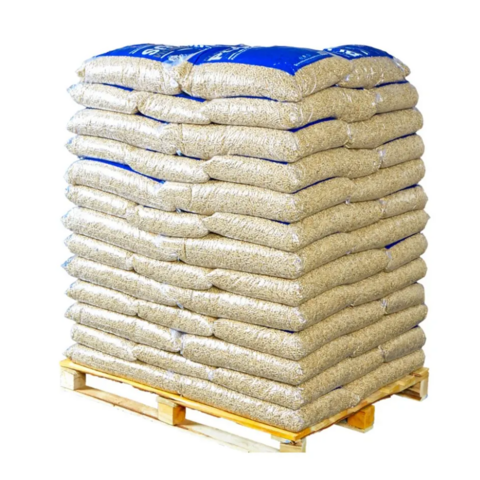
Bagged wood pellets are packaged into individual bags, commonly used for domestic heating and smaller commercial applications. Bulk vs Bagged Wood Pellets
A common retail format is the 15kg wood pellet bag, which can be handled manually and stored in a garage, utility room, warehouse or other dry protected location.
See our dedicated 15kg wood pellets page for more information.
Bagged pellets can also be supplied on pallets, making them easier to transport and distribute through retailers, distributors and commercial delivery networks.
Advantages of 15kg Bagged Pellets
The main advantages include:
- Easy manual handling
- Simple quantity control
- Convenient storage
- Easy distribution to individual customers
- No pellet silo required
- Suitable for households and smaller heating systems
- Straightforward stock rotation
- Easy identification of product and quality class
- Bulk vs Bagged Wood Pellets
For customers who consume only a few bags at a time, individual packaging can make purchasing and handling considerably easier.
What Are Big Bag Wood Pellets?
Big bags are large flexible bags designed to hold a substantially greater quantity of pellets than conventional retail bags.
They can be useful when customers want larger-volume deliveries without installing a permanent bulk silo.
Big bags may require a forklift, pallet truck, lifting equipment or another suitable handling method depending on the bag design and delivery arrangement.
ENplus documentation treats big bags as a form of bulk pellets for relevant certification requirements, although specific transport requirements can differ because the bag itself provides packaging protection.
Learn more about big bag wood pellets.
What Are Bulk Wood Pellets?
Bulk wood pellets are delivered without individual retail bags. The pellets are transported in bulk and transferred into an appropriate storage system, commonly a pellet silo.
Bulk supply is particularly relevant for:
- Large pellet heating systems
- Commercial buildings
- Heating companies
- Pellet distributors
- Industrial boilers
- Biomass energy users
- Large-scale agricultural or commercial facilities
- Bulk vs Bagged Wood Pellets
Bulk deliveries require greater planning because the customer must have suitable storage and unloading arrangements.
Our bulk wood pellets page provides more information about bulk supply options.
Bulk vs Bagged Wood Pellets: Cost Considerations
One of the most common questions is whether bulk pellets are cheaper than bagged pellets.
There is no universal answer.
The total cost depends on factors such as:
- Order quantity
- Packaging
- Transport distance
- Delivery method
- Storage infrastructure
- Loading and unloading requirements
- Supplier terms
- Delivery frequency
- Pallet handling
- Local distribution costs
- Equipment requirements
- Bulk vs Bagged Wood Pellets
Bulk purchasing can make logistical sense for larger-volume customers, but a bulk system may require investment in a silo, blower delivery system or other handling equipment.
Conversely, bagged pellets may have higher packaging and handling costs, but they can avoid the infrastructure investment associated with bulk storage.
Therefore, buyers should compare total delivered cost, not simply the advertised price per tonne.
For larger commercial requirements, see our wood pellets wholesale Portugal supply page.
Storage Requirements
Storage is one of the biggest differences between bulk and bagged pellets.
Storing Bagged Pellets
Bagged pellets should be protected from moisture.
Good storage practices include:
- Keep bags indoors whenever possible.
- Avoid direct contact with wet floors.
- Keep bags away from leaks.
- Protect bags from rain and condensation.
- Store on pallets or another suitable dry platform.
- Avoid damaging bags during handling.
- Rotate older stock first.
- Keep storage areas clean.
- Bulk vs Bagged Wood Pellets
Wood pellets can absorb moisture, which can affect their physical condition and combustion performance.
Our guide explains how to store wood pellets correctly.
Storing Big Bags
Big bags also require dry, protected storage.
The storage area should be suitable for the size and weight of the bags, with sufficient space for safe movement and handling.
Where forklifts or other equipment are used, the storage layout should allow safe access to the bags.
Storing Bulk Pellets
Bulk pellets normally require dedicated storage, such as a pellet silo.
The storage system should be designed to:
- Keep pellets dry
- Minimize contamination
- Allow controlled fuel transfer
- Provide suitable access for delivery
- Match the capacity of the heating system
- Accommodate delivery volumes
- Support safe maintenance and cleaning
- Bulk vs Bagged Wood Pellets
ENplus requirements cover storage and protection of pellets against moisture and contamination within the certified supply chain.
Delivery and Unloading
Delivery logistics are another important consideration.
Bagged Pellet Delivery
Bagged pellets are commonly transported on pallets.
The customer can receive the pallet and move individual bags as required.
This is particularly practical for:
- Households
- Retailers
- Small businesses
- Pellet distributors
- Customers without bulk unloading equipment
- Bulk vs Bagged Wood Pellets
Big Bag Delivery
Big bags provide higher-volume packaging while keeping the pellets contained.
Depending on the delivery arrangement, unloading may require:
- Forklift
- Pallet truck
- Crane or lifting equipment
- Suitable loading platform
The exact equipment depends on bag size and supplier logistics.
Bulk Delivery
Bulk deliveries require a compatible unloading arrangement.
The delivery vehicle may transfer pellets directly into the customer’s silo or storage system.
This means the buyer should confirm:
- Silo capacity
- Delivery access
- Vehicle access
- Unloading connection
- Required hose length
- Storage condition
- Delivery quantity
- Minimum order requirements
- Bulk vs Bagged Wood Pellets
For large-volume requirements, see bulk wood pellets Portugal.
Which Format Is Best for Households?
For many households, 15kg bags are practical because they do not require a pellet silo.
A homeowner can purchase a pallet or smaller quantity and store the bags in a dry location.
Bagged pellets can also make consumption easier to monitor.
For example, if a household uses 1.5kg of pellets per hour and operates a stove for several hours per day, the customer can estimate how many 15kg bags are required.
Actual consumption varies according to the appliance, operating settings, building insulation, weather and heating requirements.
Our wood pellet consumption guide explains how to calculate estimated fuel use.
Which Format Is Better for Commercial Heating?
Commercial users should evaluate their heating system and annual consumption.
A commercial facility with a dedicated pellet boiler and suitable storage may find bulk delivery operationally convenient. Bulk vs Bagged Wood Pellets
A smaller commercial customer without silo infrastructure may prefer bags or big bags.
Relevant factors include:
- Daily consumption
- Available storage
- Delivery frequency
- Access for delivery vehicles
- Unloading equipment
- Heating system requirements
- Annual pellet demand
- Labour required for handling
- Bulk vs Bagged Wood Pellets
For commercial heating requirements, see our heating pellets Portugal page.
Which Format Is Suitable for Industrial Users?
Industrial pellet users generally need to consider supply continuity, storage capacity and fuel handling infrastructure.
Large boilers and biomass systems may require substantial quantities of pellets.
In these situations, bulk delivery can integrate directly with an existing fuel storage and feeding system.
However, the appropriate supply format depends on the customer’s equipment and operating model.
See industrial wood pellets Portugal for commercial and industrial supply information.
Bulk vs Bagged Pellets for Distributors
Distributors have different requirements from end users.
A distributor may need:
- Full truck quantities
- Palletized 15kg bags
- Big bags
- Bulk deliveries
- Consistent product specifications
- Regular supply
- Product documentation
- Reliable delivery scheduling
- Stock rotation planning
- Bulk vs Bagged Wood Pellets
Bagged pellets can be convenient for resale because each unit is already packaged.
Bulk pellets can make sense where the distributor has appropriate storage and customers who purchase in larger quantities.
Our wood pellets wholesale and wood pellets wholesale Portugal pages cover wholesale supply requirements.
Quality Matters More Than Packaging Alone
A common misconception is that bulk or bagged pellets automatically have different fuel quality.
Packaging format itself does not determine pellet quality.
Buyers should instead look at the actual product specification and, where applicable, certification.
For ENplus-certified products, the certification scheme covers aspects of the pellet supply chain from production through delivery. Bulk vs Bagged Wood Pellets
ENplus documentation also requires delivery documentation for certified pellets to identify relevant information such as mass, pellet diameter, form of supply and loading or delivery date.
When purchasing certified pellets, buyers should therefore verify the certification information and documentation rather than relying only on marketing terminology.
Read our guide: What Is ENplus A1? Complete Wood Pellet Certification Guide.
Bulk, Big Bag or 15kg Bags?
The following guide can help narrow down the appropriate format.
| Customer requirement | Potentially suitable format |
|---|---|
| Home pellet stove | 15kg bags |
| Small commercial heating | 15kg bags or big bags |
| Larger commercial boiler | Big bags or bulk |
| Industrial boiler | Bulk |
| Pellet retailer | 15kg bags |
| Distributor with warehouse | 15kg bags, big bags or bulk |
| Customer without silo | 15kg bags or big bags |
| Customer with dedicated silo | Bulk |
| Occasional pellet purchase | 15kg bags |
| High-volume annual consumption | Bulk or big bags |
This is a starting point rather than a universal rule. The heating system, storage arrangement and delivery infrastructure should determine the final choice.
Bulk vs Bagged Wood Pellets: Technical Comparison
| Specification | 15kg Bags | Big Bags | Bulk |
|---|---|---|---|
| Individual packaging | Yes | Yes | No |
| Manual handling | Easy | Limited | No |
| Silo required | No | No, normally | Normally |
| Forklift useful | For pallet handling | Often | Not normally for fuel transfer |
| Suitable for retail | Yes | Sometimes | Limited |
| Suitable for households | Yes | Sometimes | Larger systems |
| Suitable for industrial users | Limited | Yes | Yes |
| Storage infrastructure | Basic | Moderate | Dedicated |
| Delivery planning | Moderate | Moderate | High |
| Stock control | Simple | Moderate | Storage-based |
| Packaging waste | Higher | Lower per tonne | Minimal packaging |
| Handling equipment | Low | Medium | Higher |
| Typical purchase planning | Bags/pallets | Large units | Tonnes/full loads |
How to Choose the Right Pellet Supply Format
Before ordering, consider the following questions.
1. How much do you consume?
Estimate daily, monthly and annual consumption.
A customer using several bags per week has different requirements from an industrial boiler consuming tonnes per day. Bulk vs Bagged Wood Pellets
2. Do you have a silo?
If not, bulk delivery may require additional infrastructure.
3. How will the pellets be unloaded?
Confirm whether you have the necessary equipment for big bags or bulk deliveries.
4. How much storage space is available?
Calculate usable storage capacity rather than simply measuring floor area.
5. How frequently do you want deliveries?
Frequent smaller deliveries may suit bagged pellets, while larger planned deliveries can suit bulk supply.
6. What is your heating system designed for?
Always follow the heating equipment manufacturer’s fuel and handling specifications.
7. What is the total delivered cost?
Consider packaging, transport, unloading, storage and equipment—not only the pellet price.
Choosing Between 15kg, Big Bag and Bulk Pellets
A simple decision framework is:
Choose 15kg bags when:
- You need convenient manual handling.
- You do not have a silo.
- You are buying for household or small commercial use.
- You want simple stock control.
- Bulk vs Bagged Wood Pellets
Consider big bags when:
- You need larger quantities.
- You have suitable handling equipment.
- You want fewer individual bags.
- You do not want a permanent bulk silo.
- Bulk vs Bagged Wood Pellets
Consider bulk pellets when:
- Your consumption is high.
- You have suitable bulk storage.
- Your heating system is designed for bulk fuel.
- You have appropriate delivery access.
- You want planned high-volume deliveries.
- Bulk vs Bagged Wood Pellets
Buying Checklist
Before placing an order for wood pellets, confirm:
- Pellet quality class
- Pellet diameter
- Packaging format
- Quantity per delivery
- Number of bags or tonnes
- Delivery location
- Delivery method
- Storage requirements
- Unloading requirements
- Certification status where applicable
- Product documentation
- Delivery schedule
- Payment terms
- Total delivered price
- Bulk vs Bagged Wood Pellets
For ENplus-certified supply, buyers can also verify the relevant certification status through the official ENplus system.
Bulk and Bagged Wood Pellets from Palmal
Palmal – Paletes de Madeira supplies wood pellets for different customer requirements, including bagged, big-bag and bulk supply options where available.
Our product range includes:
- Wood Pellets Portugal
- 15kg Wood Pellets
- Big Bag Wood Pellets
- Bulk Wood Pellets
- Bulk Wood Pellets Portugal
- Heating Pellets
- Industrial Wood Pellets
- Wood Pellets Wholesale
- ENplus A1 Wood Pellets
- Bulk vs Bagged Wood Pellets
For customers comparing formats, we can assess the required quantity, packaging, delivery destination and intended application before preparing a quotation.
Frequently Asked Questions
Are bulk wood pellets cheaper than bagged pellets?
Not necessarily. The total cost depends on quantity, transport, packaging, storage, unloading and supplier terms. Bulk purchasing may be economically suitable for high-volume users, but the required infrastructure should also be considered.
Are bulk and bagged pellets the same quality?
They can be produced to the same quality specification. Packaging format alone does not determine pellet quality. Buyers should check the product specification and certification where applicable.
Are 15kg wood pellets suitable for commercial heating?
Yes. They can be suitable for smaller commercial heating systems, although larger facilities may prefer big bags or bulk delivery depending on consumption and storage.
Do bulk pellets require a silo?
Bulk pellets normally require suitable bulk storage, commonly a pellet silo. The storage system should be compatible with the heating installation and delivery method.
What is a big bag of wood pellets?
A big bag is a large flexible container used to transport and store a larger quantity of pellets than conventional retail bags. Handling requirements depend on the bag size and delivery system.
Can ENplus pellets be supplied in bulk?
Yes. ENplus certification covers bulk pellets as well as other supply formats. The applicable requirements include quality control, documentation, handling and delivery processes.
How should bagged wood pellets be stored?
Keep bags dry, protected from rain and moisture, and preferably elevated from potentially damp floors. Avoid damaged packaging and rotate older stock first.
Which pellet format is best for a pellet stove?
For many household pellet stoves, 15kg bags are convenient because they can be manually handled and do not require a bulk silo. Always follow the stove manufacturer’s fuel and loading requirements.
Which format is suitable for an industrial boiler?
Industrial users commonly evaluate bulk supply because of higher consumption and existing fuel-handling infrastructure. However, the appropriate format depends on the boiler, storage system and delivery setup.
Related Resources
For more information about wood pellets, see:
- What Is ENplus A1? Complete Wood Pellet Certification Guide
- How to Store Wood Pellets Properly
- How Many Wood Pellets Does a Pellet Stove Use?
- Softwood vs Hardwood Pellets
- Wood Pellets Portugal
- Wood Pellets Wholesale Portugal
- Bulk vs Bagged Wood Pellets
For official information about the ENplus certification scheme and its requirements, visit the official ENplus quality scheme and ENplus technical documentation.
Request a Wood Pellet Supply Quote
Whether you need 15kg bagged pellets, big bags or bulk wood pellets, the appropriate supply format depends on your consumption, storage and delivery requirements.
Contact Palmal – Paletes de Madeira with your required quantity, delivery location, preferred packaging format and intended application. Bulk vs Bagged Wood Pellets
We can then prepare a commercial quotation based on your requirements.
Request a quotation for wood pellets today.