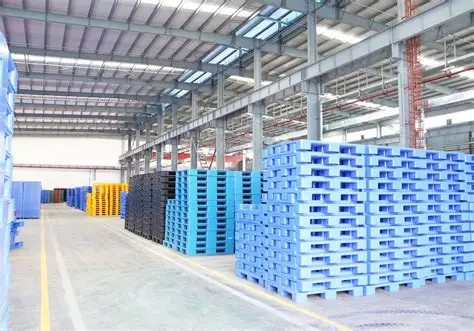
How Much Weight Can a Plastic Pallet Hold? Load Capacity Guide
Plastic pallet load capacity depends on the pallet design, material, dimensions, support conditions and the way the load is placed and handled. There is no single weight limit that applies to every plastic pallet.
A plastic pallet designed for light warehouse handling may have a very different capacity from a heavy-duty industrial pallet designed for high loads or racking. Buyers should therefore distinguish between static load, dynamic load and racking load when selecting a pallet.
This guide explains plastic pallet load capacity, the main factors that affect performance, and how to select the appropriate pallet for warehousing, logistics, manufacturing, export and industrial applications.
Plastic Pallet Load Capacity at a Glance
| Load condition | What it means | Why it matters |
|---|---|---|
| Static load | Load while the pallet remains stationary | Important for floor storage and stacking |
| Dynamic load | Load while the pallet is being moved | Important for forklifts and pallet trucks |
| Racking load | Load while supported in a warehouse rack | Critical for rack storage |
| Concentrated load | Weight concentrated in a small area | Can create higher stress |
| Distributed load | Weight spread across the pallet deck | Generally provides more uniform loading |
Always use the manufacturer’s specified capacity for the exact pallet model rather than applying a generic figure to all plastic pallets.
What Is Plastic Pallet Load Capacity?
Plastic pallet load capacity is the maximum load a pallet is designed to support under specified conditions.
The capacity can change depending on whether the pallet is:
- Sitting on a solid floor
- Stacked with another pallet
- Being moved by a forklift
- Being moved by a pallet truck
- Supported by warehouse racking
- Loaded evenly
- Loaded with concentrated weight
- Used in different temperatures
- Used repeatedly over time
- plastic pallet load capacity
For this reason, a pallet may have separate ratings for static, dynamic and racking applications.
Static Load Capacity
Static load capacity refers to the load a pallet can support while stationary on an appropriate, continuous supporting surface.
For example, a pallet loaded with cartons and positioned on a warehouse floor is primarily subject to static loading.
Static capacity is often higher than dynamic or racking capacity because the pallet is not being lifted or subjected to the same handling stresses.
However, buyers should not assume that a high static rating automatically means the pallet is suitable for rack storage.
Example
A pallet might be designed for a high stationary load but have a lower permitted capacity when:
- Lifted by a forklift
- Moved using a pallet truck
- Placed into selective racking
- Supported only at specific points
- plastic pallet load capacity
The manufacturer’s technical specification should always be followed.
Dynamic Load Capacity
Dynamic load capacity refers to the load the pallet is designed to carry while being handled or moved.
Dynamic applications can include:
- Forklift handling
- Pallet truck movement
- Warehouse transfers
- Loading and unloading
- Manufacturing-line movement
- Distribution operations
- plastic pallet load capacity
Moving a loaded pallet introduces forces that are not present when the pallet is stationary.
The pallet therefore needs sufficient structural strength and rigidity for the intended handling equipment.
Racking Load Capacity
Racking load capacity is particularly important in warehouses where pallets are stored on racking systems.
A rack-supported pallet does not have the same support conditions as a pallet sitting on a solid floor.
The pallet may be supported along particular rails or contact points, meaning the deck and structural components must withstand the load across those supports.
Not every plastic pallet is suitable for racking.
If your warehouse uses selective racking, drive-in systems or another rack configuration, confirm that the specific pallet has been tested or specified for that application.
Why Plastic Pallet Capacity Varies
Two plastic pallets with identical external dimensions can have substantially different load capacities.
The difference can come from:
- Pallet weight
- Plastic formulation
- Structural design
- Deck thickness
- Rib configuration
- Number and position of feet
- Reinforcement
- Steel inserts
- Manufacturing method
- Temperature
- Support conditions
- Intended handling system
- plastic pallet load capacity
A lightweight nestable pallet should not be compared directly with a reinforced heavy-duty rackable pallet simply because both measure 1200 × 800 mm.
Dimensions and Load Capacity
Pallet dimensions affect how loads are distributed.
Common European pallet dimensions include:
- 1200 × 800 mm
- 1200 × 1000 mm
- 1140 × 1140 mm
- Other application-specific dimensions
The correct size depends on the product, warehouse layout, transport equipment and handling requirements.
See our Plastic Pallets Europe page for information about plastic pallet solutions for European logistics.
Heavy-Duty Plastic Pallets
Heavy-duty plastic pallets are designed for applications where higher structural performance is required.
They can be used in environments such as:
- Manufacturing
- Automotive logistics
- Heavy industrial distribution
- Warehousing
- Export logistics
- Chemical logistics
- Food and beverage operations
- Closed-loop supply chains
- plastic pallet load capacity
Some heavy-duty designs incorporate reinforced structures or steel reinforcement to improve performance under demanding conditions.
See our heavy duty plastic pallets page for more information.
How Load Distribution Affects Capacity
The way goods are placed on a pallet is just as important as the nominal pallet rating.
A uniformly distributed load places weight across a larger portion of the deck.
A concentrated load places more force into a smaller area.
For example, a pallet carrying several evenly distributed cartons may experience a different loading pattern from a pallet carrying one extremely heavy machine component.
When loading a pallet:
- Keep the center of gravity controlled.
- Distribute weight as evenly as practical.
- Avoid unnecessary overhang.
- Secure unstable loads.
- Follow the pallet manufacturer’s instructions.
- Consider the actual support conditions.
- plastic pallet load capacity
Center of Gravity Matters
A high or uneven center of gravity can make a loaded pallet more difficult to handle safely.
Even when the total weight is below the pallet’s rated capacity, an unstable load can create handling problems.
Heavy goods should generally be positioned to maintain a stable load configuration.
This is particularly important when pallets are:
- Forklifted
- Moved over uneven surfaces
- Loaded into trucks
- Stored at height
- Transferred between warehouse zones
- plastic pallet load capacity
Plastic Pallet Load Capacity and Temperature
Temperature can affect plastic performance.
Different plastic materials behave differently under temperature extremes.
A pallet specification intended for normal warehouse conditions should not automatically be assumed to have identical performance in:
- Freezers
- Cold stores
- Hot production areas
- Outdoor environments
- Heated processing areas
- plastic pallet load capacity
For cold-chain applications, confirm that the selected pallet is appropriate for the operating temperature.
This is particularly relevant for food grade plastic pallets and hygienic plastic pallets used in food and beverage logistics.
Plastic Pallet Capacity in Cold Storage
Cold environments can affect the mechanical characteristics of plastics.
If pallets are being used in refrigerated warehouses or freezers, buyers should check the manufacturer’s temperature specifications.
The relevant question is not simply:
“How many kilograms can the pallet hold?”
It is:
“How many kilograms can this specific pallet safely carry under our actual operating conditions?”
That distinction is important for reliable pallet selection.
Rackable vs Non-Rackable Plastic Pallets
One of the most important distinctions for warehouse buyers is whether the pallet is designed for racking.
Rackable pallets
These pallets are designed for specific rack-support conditions.
They may incorporate structural features such as:
- Reinforced deck
- Stronger perimeter structure
- Reinforced feet
- Steel reinforcement
- Designed support spans
- plastic pallet load capacity
Non-rackable pallets
These may be suitable for:
- Floor storage
- Stacking
- Transport
- Distribution
- General material handling
- plastic pallet load capacity
But they should not automatically be used in warehouse racking.
See our article on plastic pallet types for more information about rackable, stackable and nestable designs.
Stackable Plastic Pallets
Stackable pallets are designed to support pallets or loads above them under specified conditions.
When stacking loaded pallets, several factors matter:
- Total load
- Pallet design
- Load stability
- Floor condition
- Product packaging
- Stack height
- Center of gravity
- Manufacturer’s stacking specification
- plastic pallet load capacity
A pallet’s static load rating should not be interpreted as permission to create any stack height.
The complete storage system needs to be considered.
Nestable Plastic Pallets
Nestable pallets are designed so empty pallets can fit inside one another.
This reduces the space required to store and transport empty pallets.
Nestable designs are often useful for:
- Distribution
- Return logistics
- Export
- Retail supply chains
- Empty pallet transport
- plastic pallet load capacity
However, nestability does not automatically indicate a particular load rating.
Always compare the technical specifications of the individual pallet model.
Plastic Pallet Load Capacity for Export
Plastic pallets can be useful for international shipping because they do not require the same wood-packaging treatment considerations as untreated wooden pallets.
For export applications, buyers should still consider:
- Destination requirements
- Pallet dimensions
- Container loading
- Forklift compatibility
- Load weight
- Cargo stability
- Product packaging
- Handling conditions
- plastic pallet load capacity
See our export plastic pallets page for more information.
Plastic vs Wooden Pallet Load Capacity
It is not accurate to say that plastic pallets universally carry more or less weight than wooden pallets.
Both materials are available in different designs and load classes.
The comparison should instead consider the specific pallet model and operating conditions.
| Factor | Plastic Pallet | Wooden Pallet |
|---|---|---|
| Static capacity | Model-dependent | Model-dependent |
| Dynamic capacity | Model-dependent | Model-dependent |
| Racking capacity | Available on suitable designs | Available on suitable designs |
| Moisture resistance | Generally high | Depends on wood and treatment |
| Consistency | Highly consistent manufacturing | Can vary with condition and construction |
| Repairability | Generally limited compared with wood | Often repairable |
| Hygiene | Washable designs available | More difficult to wash thoroughly |
| Weight | Design-dependent | Design-dependent |
| Export considerations | No wood ISPM 15 treatment | ISPM 15 may apply depending on shipment |
For a broader material comparison, see Plastic vs Wooden Pallets: Complete Comparison for Businesses.
Common Plastic Pallet Load Classes
Plastic pallet suppliers may describe products using categories such as:
- Light-duty
- Medium-duty
- Heavy-duty
- Rackable
- Industrial
- Export
- Hygienic
These descriptions are useful for initial product selection, but they should not replace the manufacturer’s actual technical data.
A buyer should request the relevant load ratings for the exact pallet model.
What Information Should You Request From a Supplier?
Before purchasing plastic pallets for a heavy-load application, ask the supplier for:
- Pallet dimensions
- Pallet weight
- Static load capacity
- Dynamic load capacity
- Racking load capacity
- Recommended temperature range
- Material specification
- Reinforcement details
- Forklift compatibility
- Pallet truck compatibility
- Stacking information
- Intended application
- Product test documentation where applicable
- plastic pallet load capacity
This gives you a much better basis for selecting the correct pallet than simply asking for “a strong plastic pallet.”
Example Load-Selection Scenarios
Scenario 1: Warehouse floor storage
A company stores boxed products directly on a warehouse floor.
The primary considerations are:
- Static capacity
- Stacking capacity
- Load distribution
- Pallet dimensions
- Handling equipment
- plastic pallet load capacity
A suitable standard or heavy-duty plastic pallet may meet the requirement depending on the actual load.
Scenario 2: Selective racking
A warehouse stores pallets several metres above floor level.
The buyer should specifically request a rackable plastic pallet with a documented racking load rating appropriate to the rack configuration.
A general static capacity is not enough.
Scenario 3: Heavy machinery components
A manufacturing company transports concentrated metal components.
The buyer should consider:
- Concentrated loading
- Deck strength
- Load distribution
- Dynamic handling
- Center of gravity
- Forklift handling
- plastic pallet load capacity
A reinforced industrial pallet may be appropriate depending on the actual load.
Scenario 4: Food distribution
A food distributor needs washable pallets for repeated logistics cycles.
Relevant factors may include:
- Hygienic design
- Washability
- Load capacity
- Temperature resistance
- Cleaning procedures
- Handling equipment
- plastic pallet load capacity
See our food grade plastic pallets and reusable plastic pallets pages.
How to Calculate the Required Pallet Capacity
Start with the maximum actual load placed on one pallet.
For example:
20 boxes × 50 kg = 1,000 kg
The pallet must then be evaluated for the relevant operating condition.
If the same 1,000kg load is:
- Stored on the floor
- Moved by forklift
- Stored in racking
the required ratings may differ.
Do not simply select a pallet rated at exactly 1,000kg without considering a suitable operating margin and the manufacturer’s specified conditions.
The supplier should confirm the appropriate pallet for the application.
Load Capacity Is Not the Same as Product Weight
The pallet’s own weight should not be confused with its load capacity.
A heavier pallet may have a stronger structure, but pallet weight alone does not establish its safe working load.
For example, two pallets could weigh different amounts while having similar or very different load ratings.
Always use the manufacturer’s technical specification.
Plastic Pallets for Reusable Logistics
Reusable plastic pallets are often selected for closed-loop or repeated logistics systems.
Applications can include:
- Manufacturer to distribution center
- Warehouse-to-warehouse transport
- Automotive supply chains
- Food distribution
- Retail distribution
- Export logistics
- Internal factory movements
Repeated use makes structural consistency particularly important.
Learn more about reusable plastic pallets.
Plastic Pallet Load Capacity Checklist
Before selecting a pallet, confirm:
- Maximum load: What is the heaviest actual pallet load?
- Load distribution: Is the weight evenly distributed?
- Handling: Forklift, pallet truck or conveyor?
- Storage: Floor, stacking or racking?
- Temperature: Normal, refrigerated or freezer?
- Dimensions: Which pallet size fits the operation?
- Frequency: Single-use or repeated cycles?
- Environment: Dry, wet, food, chemical or industrial?
- Export: Is international shipping involved?
- Reinforcement: Is steel reinforcement required?
- Documentation: Are technical specifications available?
Frequently Asked Questions
How much weight can a plastic pallet hold?
There is no single capacity for all plastic pallets. Capacity depends on the specific model and whether the load is static, dynamic or supported in racking.
What is the difference between static and dynamic pallet capacity?
Static capacity refers to a pallet supporting a load while stationary. Dynamic capacity refers to the load the pallet is designed to carry while being moved.
Can plastic pallets hold 1,000 kg?
Some plastic pallets are designed to carry loads of 1,000kg or more, but the actual capacity depends on the model, load distribution and operating conditions.
Can plastic pallets hold 1,500 kg?
Some heavy-duty plastic pallets can be designed for loads around this level or higher. However, buyers should verify the manufacturer’s static, dynamic and racking specifications for the exact pallet.
Are all plastic pallets suitable for warehouse racking?
No. A plastic pallet should only be used in racking when its design and specified load rating are suitable for the rack system and support conditions.
Are heavy-duty plastic pallets better for heavy loads?
Heavy-duty designs are intended for demanding applications, but the correct pallet should still be selected based on the actual load, handling method and storage system.
Can plastic pallets be used in freezers?
Some plastic pallets are suitable for cold and freezer environments. Confirm the manufacturer’s temperature specification before use.
Are plastic pallets suitable for export?
Plastic pallets can be suitable for international export, subject to the requirements of the destination, carrier, cargo and logistics operation.
What is the strongest type of plastic pallet?
There is no universal “strongest” plastic pallet. Heavy-duty and reinforced models are designed for demanding applications, but the correct choice depends on the specific load and operating conditions.
Plastic Pallets from Palmal
Palmal – Paletes de Madeira supplies plastic pallet solutions for logistics, warehousing, manufacturing, food handling, export and industrial applications.
Our range includes:
- Plastic Pallets
- Heavy Duty Plastic Pallets
- Industrial Plastic Pallets Europe
- Reusable Plastic Pallets
- Food Grade Plastic Pallets
- Hygienic Plastic Pallets
- Export Plastic Pallets
- Plastic Pallets for Warehousing & Logistics
- Plastic Pallets Portugal
- Plastic Pallets Europe
When requesting a quotation, provide the pallet dimensions, maximum load, storage method, handling equipment and delivery destination whenever possible.
This allows the appropriate pallet specification to be identified before ordering.
Final Checklist: Selecting Plastic Pallet Load Capacity
The correct plastic pallet should be selected based on the complete operating environment, not a single advertised weight figure.
Before purchasing, establish:
- Maximum load per pallet
- Static load requirement
- Dynamic load requirement
- Racking requirement
- Load distribution
- Pallet dimensions
- Handling equipment
- Storage method
- Temperature conditions
- Reuse requirements
- Export requirements
- Supplier technical documentation
For high-load warehouse and industrial applications, selecting the correct specification in advance can help prevent pallet failure, handling problems and unsuitable warehouse storage.
Need plastic pallets for a specific load? Contact Palmal – Paletes de Madeira with your required dimensions, load weight, application and delivery location for a commercial quotation.